
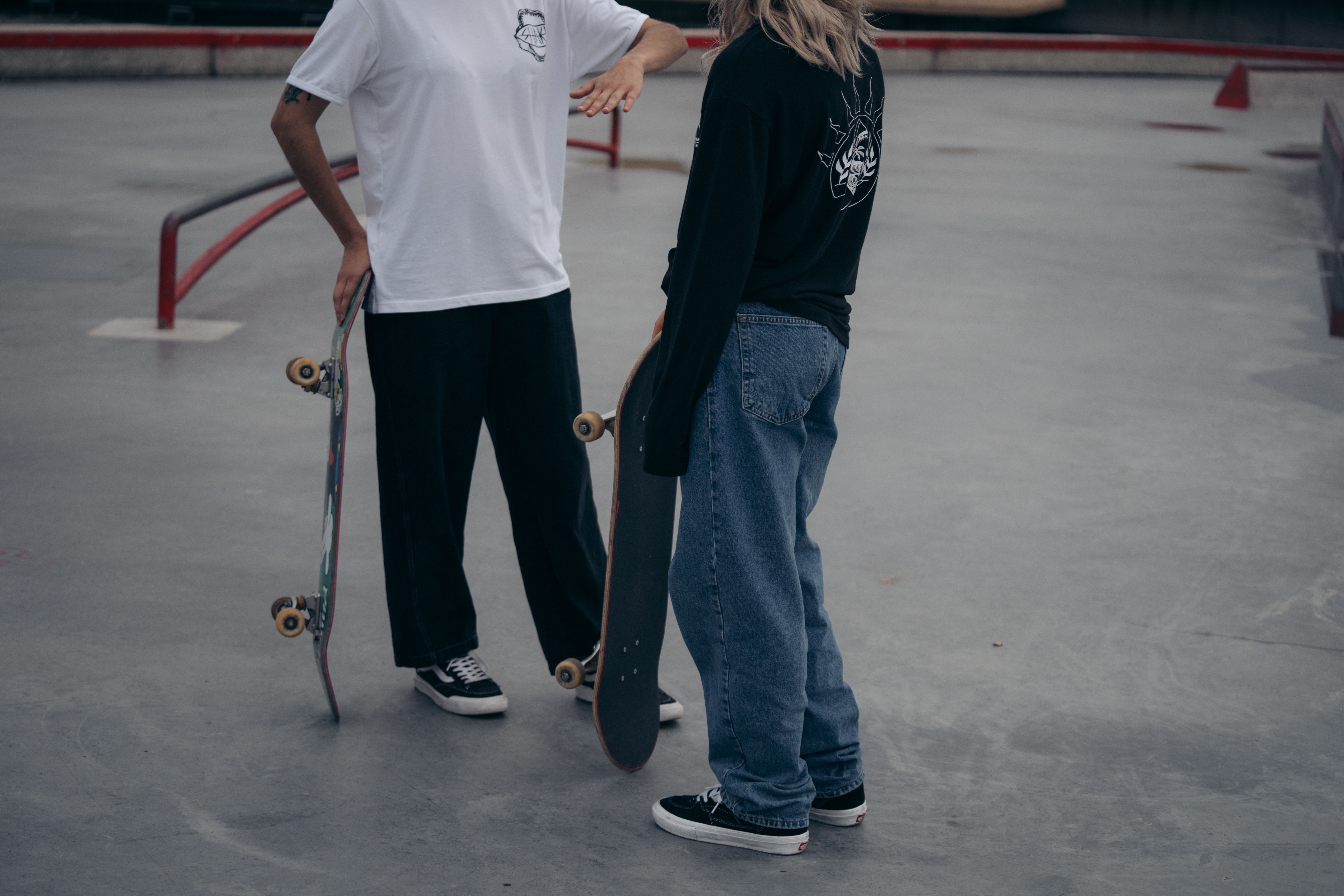
Streetwear has been cut generously for decades, through several changes in what surrounds it. The reasons are partly historical and partly practical, and the practical ones explain why it persists.
The source garments were never fitted
Streetwear draws directly on workwear, military surplus, sportswear and skate clothing, all of which were cut for movement and layering rather than for line.
A work jacket has to fit over other clothing, and a basketball jersey has to allow a full range of arm movement without pulling.
Adopting those garments meant adopting their proportions, and the proportions became part of what identified the clothing rather than an incidental feature.
Loose fit tolerates sizing error
A fitted garment is wrong if it is one size out. A loose garment worn deliberately large has a much wider band of acceptable fit.
That matters enormously for a category sold heavily online and through limited releases where trying on is impossible and exchanges are often unavailable.
It also matters for resale, since a garment that fits a wide range of buyers has a larger market than one that fits precisely.
Production economics favour fewer sizes
Every size in a run is a separate pattern grade and a separate quantity decision, and unsold sizes are dead stock.
A relaxed cut allows a shorter size range to cover the same customers, which reduces both pattern work and inventory risk on a limited release.
For a small brand producing a few hundred units, that difference determines whether a drop sells through cleanly or leaves awkward remainders.
Volume photographs better than fit
A great deal of streetwear is judged from images before it is ever seen in person, and volume reads clearly at small sizes on a screen.
Silhouette survives compression and thumbnails in a way that tailoring detail does not, so a garment defined by its shape communicates faster than one defined by its cut.
Graphics benefit as well, since a larger panel gives a print more room and keeps it legible when the image is scaled down.
The proportions are deliberate rather than simply large
Well-made oversized garments are redrafted rather than scaled up. Shoulder seams are dropped intentionally, armholes are lowered and body length is adjusted to match.
Simply grading a fitted pattern several sizes larger produces a garment that is wide and also too long in the sleeve and wrong at the neck.
This is the clearest difference between considered streetwear and imitation of it, and it is visible in where the shoulder falls rather than in how much fabric is present.