
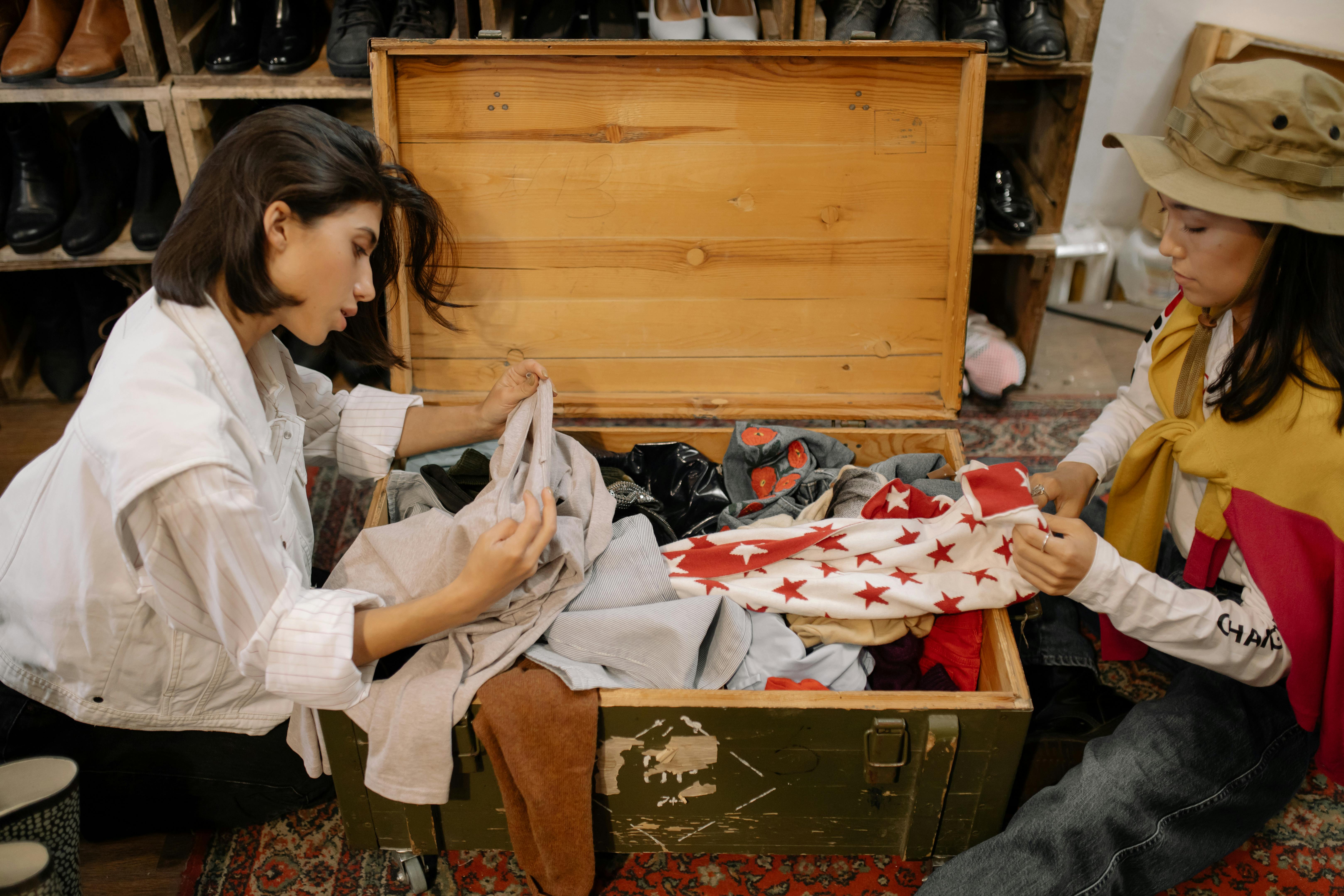
Putting clothes into a donation bin feels like an ending. It is the start of a supply chain that is larger and more commercial than most donors expect.
The first sort
Charities and collectors sort donated clothing by quality and category.
A small proportion — generally a minority — is suitable for sale in domestic charity shops, which is where the highest value is captured.
The rest is sold in bulk to commercial textile merchants by weight.
Which is a genuine revenue stream for charities and is not what most donors imagine is happening.
Grading
Merchants sort into a large number of grades — by garment type, condition, fibre, season and destination market.
This is labour intensive and is done by hand, largely in countries with lower labour costs, which is why bales travel before being sorted.
Sorters develop considerable expertise in what will sell where, since different markets have quite different demand.
The export trade
Graded second-hand clothing is exported in bulk, principally to markets in Africa, Eastern Europe, South Asia and Latin America.
It arrives in bales that traders buy without seeing the contents, then sell in local markets.
This supports a substantial employment sector — traders, tailors who alter garments, repairers — and provides affordable clothing.
It also faces sustained criticism for undermining domestic textile industries, and several countries have restricted or attempted to ban imports for that reason.
The arguments on both sides have substance and the trade continues at scale.
The quality problem
The most significant recent change.
As clothing produced globally has shifted toward lower-cost synthetic garments with short lifespans, the quality of what enters the second-hand stream has fallen.
Which means a rising proportion of imported bales contains items that cannot be sold and become waste in the receiving country.
Those countries frequently lack waste infrastructure to handle the volume, and the resulting accumulation has been extensively documented.
This is the strongest criticism of the trade and it is a consequence of production decisions made elsewhere.
Downcycling
Material not suitable for reuse goes to other applications.
Wiping cloths for industrial use. Shredded fibre for insulation, carpet underlay and automotive padding.
These are genuine uses and they are terminal — the material cannot progress further and is eventually landfilled or burned.
Which is why the term recycling in this context frequently means downcycling, and the distinction matters.
Fibre-to-fibre recycling
The thing that would actually close the loop, and it remains limited.
Mechanical recycling shreds fabric back to fibre, which shortens the staple length and produces weaker yarn, so recycled content is generally blended with virgin fibre.
Chemical recycling breaks polymers down to their building blocks and rebuilds them, which can produce material equivalent to virgin.
The obstacles are blended fabrics, which cannot readily be separated, and dyes and finishes that complicate processing.
Which means the single-fibre garment is far more recyclable than the blend, and blends dominate production.
Take-back schemes
Retailer collection programmes have grown, offering a discount in exchange for returned clothing.
Material collected generally enters the same commercial stream as donations.
The criticism is that offering a purchase incentive for disposal encourages replacement, which may increase total consumption rather than reduce it.
Disclosure of what happens to collected material varies considerably between schemes and is generally poor.
What actually helps
Donating only what someone would genuinely wear, and disposing of the rest properly rather than passing the sorting cost down the chain.
Selling or giving directly, which keeps the garment in use locally with no intermediary.
And buying less, which is the intervention that addresses the volume rather than the destination.
None of this is a reason not to donate. It is a reason to be realistic about what donation accomplishes, which is redistribution rather than disposal.
The economics of a charity shop
Worth understanding because it explains what is worth donating.
Shop space is the constraint. Every item on the floor occupies space that could hold something that sells faster.
Which means volunteers sort ruthlessly, and items that will not sell quickly go straight to the bulk stream regardless of condition.
Seasonality matters — donating winter coats in spring means they are stored or sold on, since shops cannot hold stock.
Clean, current, complete and seasonal is what actually raises money, and everything else is a disposal cost passed to the charity.
Extended producer responsibility
The policy direction that may change the whole picture.
Several jurisdictions have introduced or proposed schemes requiring producers to fund the collection and treatment of textiles they place on the market.
Which internalises a cost currently borne by charities, municipalities and receiving countries.
Where similar schemes exist for packaging and electronics, they have measurably changed product design, since a producer paying for disposal has a reason to design for it.
Whether the fee levels proposed are high enough to have that effect on textiles is the open question.